

Deuteronomy 8 study guide: 9/3-9/9
Here's what we're reading at the church this week. This could get interesting as this passage often comes up in defending Prosperity Gospel stuff, and we're in the middle of a sermon series on what it means to serve the poor, with the poor and just what do we mean when we say "poor."
According to verse 2, the wilderness wandering was for developing humility. What is the connection between humility and receiving God’s blessing?
Has God ever disciplined you? What was the experience like?
Why is the parent imagery in verse 5 significant?
What connects verses 5 and 6? Why should Israel keep God’s commands?
How does this compare with Psalm 23?
How is the Promised Land described? Why is this important?
According to verse 11, what are some ways the people can forget God?
According to verse 13, what gets multiplied? Do you think this should be taken literally or figuratively? Why or why not?
What are these verses saying about wealth and prosperity?
What does this mean for Christians today?
What does this say about the character of God?
What is Exodus 16 about? What does this have to do with Deuteronomy 8?
From the context of Deuteronomy 8, what does Jesus mean when he quotes Deut. 8:3 to the devil?
How many times are the words “remember” or “forget” or similar words used in this chapter?
What would you say this whole passage is about?
How does this chapter help us better understand what it means to love God with our whole heart?
Remember that chapters 4–11 in Deuteronomy are one continuous sermon. How does chapter 8 fit with what came before in chapters 4–7?
Labels: bible study, church, deuteronomy, old testament, the rock
posted by Peter at 10:25 PM
|
|
permalink |
Sunday, July 29, 2007
Beautiful abode worthy of God
Message of GOD, the Master. On the day I scrub you clean from all your filthy living, I'll also make your cities livable. The ruins will be rebuilt. The neglected land will be worked again, no longer overgrown with weeds and thistles, worthless in the eyes of passersby. People will exclaim, "Why this weed patch has been turned into a Garden of Eden! And the ruined cities, smashed into oblivion, are now thriving!" The nations around you that are still in existence will realize that I, GOD, rebuild ruins and replant empty waste places. I, GOD, said so, and I'll do it. --Eugene Peterson, The Message, Ezekiel 36:33-36
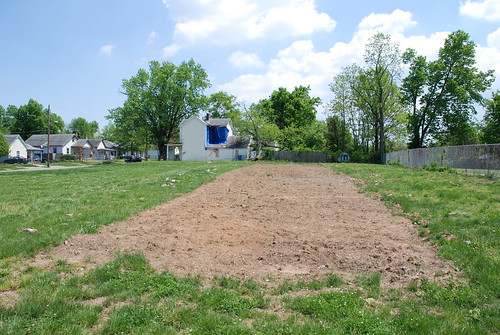
I think it's significant that when God first made people, He put them in a garden. It's not the forest of Eden, not the plain of Eden, not even the suburb of Eden or urban-dwelling of Eden. It's the Garden of Eden. I think that's important. God made us for gardens.
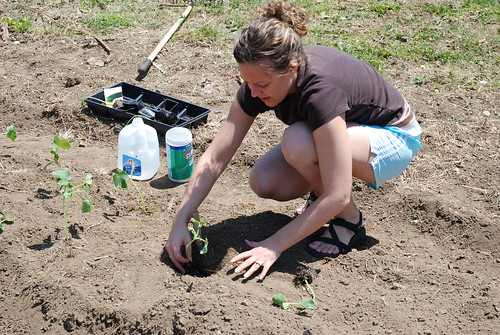
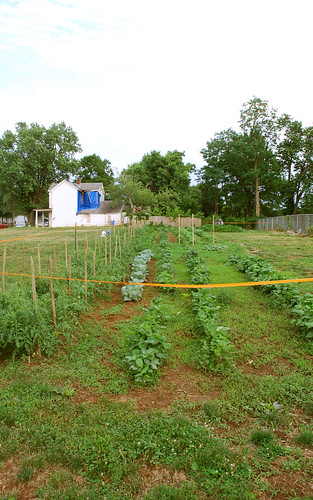
There's a vacant lot on Arceme Ave behind Arlington Elementary school, just across the street from the church. A couple months ago, we at the church started planting a garden on that lot. Jackie and I try to watch over the cucumber/zucchini squash/pumpkin/okra section that we helped plant. We try to make it out about once a week to do some weeding and spread out some coffee grounds, which enrich the soil. If you've been following Aaron's blog over the last few months, you know the story.
We've done this for a whole bunch of reasons. We of the church end up hanging out and working on a project with others we may not usually talk to. We end up talking with people in the neighborhood who want to know what in the world is going on. We've got fresh vegetables to give away to people in the community who can't afford good produce and end feeding their kids McDonalds or White Castle. We get to be what I think Jean Vanier is after when he talks about being a gospel "sign to the community." I really like this idea of reclaiming and redeeming these forsaken and abandoned places in the city.

But the craziest thing is still coming. It all started with a visit from three strangers. (Seriously, when three strangers show up on your door, you gotta pay attention.) Aaron says it this way,
Three guys show up at the church this afternoon. They represent a growing coalition of community gardeners. They heard about what we are doing at Third Street Stuff, a coffee house 7 or 8 blocks down Lime. We spent some time riffing on outrageous ideas for community gardens. A realtor told one of the guys he could have 15 vacant lots. We just need the manpower. We talked Farmer’s Market right here at the Rock, we talked food access Northside vs. Southside, we talked setting up small businesses to market fresh, local produce to some of the upscale restaurants, and we talked about what one guy called “gardens of eatin’” at houses of worship. They are setting up a garden tour of various community gardens to get us all hooked up and let people and government know what we’re up to and the positive benefits of the work.So one thing leads to another and this week is the garden tour--Thursday from 9am to 12pm. There was even a big write up in Saturday's Herald-Leader. And you can find all the details over at sustainlex.org. You should come. It starts and ends at The Rock / La Roca.
God likes gardens. And now we get the opportunity to tell people passionate about making "beautiful abodes worthy of man," as Emerson says, that we do this to make a beautiful abode worthy of God, too.
Labels: church, community, garden, lexington, old testament, the rock
posted by Peter at 11:37 PM
|
|
permalink |
Thursday, July 19, 2007
Starting Deuteronomy
Yesterday was my first attempt at grilling steaks on my new toy. They turned out quite tasty. Maybe it's beginner's luck. But the rub I made out of paprika, garlic powder, basil, chili powder and thyme didn't hurt.
Jackie's on her second overnight at her new job. Pray for her. I gotta think it's pretty weird coming home just the sun is coming up. This morning, my alarm to get up went off 10 minutes after she crawled in bed.
Last Sunday we kicked off a new study through the book of Deuteronomy at The Rock. I personally think that reading Scripture in community is important. While we as evangelicals put a high emphasis on personal Bible reading, I think we miss a lot of the time the great value in reading Scripture together. There may be stuff that you see that I don't and stuff I see that you don't. I think the more eyes we put on a text, the more we all see together. I'd really like to read this book to see how it applies to reading Scripture together.
A couple weeks ago in the Sunday service I made an announcement about this. I talked about the Never Ending Story--how it's one of my favorite movies. I love the scene at the beginning, where the shopkeeper is warning Bastian away from the book: "This book isn't safe!" Yeah, I think the Bible is kinda like that.
Anyway, on Sunday we just did a quick overview and outline of the book. I started out wondering why we should look at the Old Testament in the first place, much less Deuteronomy. Jesus says some glowing stuff about the OT. Paul does, too. In more than one place. But two narratives that to me best show what Christians do with the OT are from the Gospels. The first is Luke 24:13-25, the road to Emmaus. As Jesus explains to these shell shocked disciples, the Resurrection only makes sense in light of Moses and the prophets. The second is Mark 9:2-8, the Transfiguration. Here, in front of Moses (the Law), Elijah (the Prophets) and Peter, James, and John (the apostles/Church), the voice tells them all the listen to Jesus. So as we read the words of Moses in Deuteronomy, we listen for Jesus. I may never stand before SBL and get away with that, but I can in a Sunday school class.
Next we talked some about how Deuteronomy isn't our book. It's a book for 3000-year-old Israelites. It's not a book for 21st century, English-speaking, Western, white folk. There are a lot of cultural barriers to cross, because there's a lot of weird stuff in there. On the other hand, it is our book. If we take "authorial intent" seriously, and the inspiration of the Spirit seriously, then the same Spirit that first breathed these words still speaks to us, the Church. So, in that sense, it is our book.
And then I did some talk about Deuteronomy as an ancient near eastern suzerainty treaty. I read a couple of sections from a Hittite treaty dating back to about 1500 BC. There are a lot of striking similarities. If the book started out, "once upon a time," we would expect a certain set of conventions. Because it starts out, "these are the words..." as these treaties do, we can then expect that structure. The point being that what is recorded here has some historical credence. We're listening to a God that intervenes with human history. And next week we'll start digging into chapter 1.
So if you happen to me in north Lexington on a Sunday morning at 10 am, feel free to drop by and say hello.
Labels: bible, bible study, church, deuteronomy, old testament, scripture, the rock
posted by Peter at 11:28 PM
|
|
permalink |
Tuesday, March 20, 2007
Thinspace thoughts
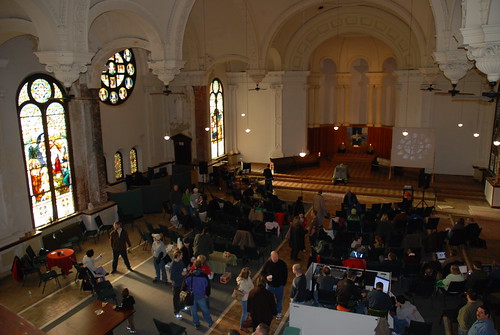
I think I'm a liturgical Metho-matic. I'm stealing that from Kevin S.
I've spent the last several months thinking a lot about hospitality, reading a lot about hospitality, writing a lot about hospitality. This weekend I got to receive it. Kevin and his wife Becky welcomed Jackie and I to crash the night at their place.
Saturday in one of the breakout sessions, we were each introducing ourselves and offering some context to our background. "I'm a liturgical Metho-matic," says Kevin. He loves liturgy and has roots in Methodism and charismatic stuff. Hey, me, too.
***
"Thinspace" is a term having to do with closeness. Closeness both between people and between the invisible world with the visible. That place where they almost touch. That was the theme of the weekend.
***
"People convert themselves," said Casper. The morning "speaker" Saturday was a conversation between Matt Casper and Jason Evans. Casper is an atheist. Jason is responsible for things like Ecclesia. But they're, like, best pals.
So anyway, I was struck by Matt's comment. Because I agree, totally, but I don't, totally. In context, he was arguing that people are not converted by arguments and propositional statements. Lee Strobel does nothing for him. And I agree. Charts and graphs and logic didn't lead me to repentance. (as an aside, "repentance" has nothing to do with your sins. Jesus never said "repent of your sins." He said "Repent." It has to do with your mind and how you think.) (as another aside, why doesn't children's church have the kids memorize Romans 2:4b?)
But I disagree. People don't convert themselves; the Holy Spirit does.
***
One highlight of the weekend for me was hearing from Bob Ekblad. Bob has recently written a book called Reading the Bible with the Damned. He's also responsible for a group called Tierra Nueva. I found his story pretty fascinating, as he weaved together his experience from working with peasant farmers in Guatemala to undocumented workers in Washington state, to the Toronto revival to being a jail chaplain in Skaggit Cty. All the while, his narrative was framed by Isaiah 61 and Jesus' appropriation of it in Luke 4. I'm not sure if I've ever heard someone hold in tension spiritual deliverance and social advocacy, of presence and healing, both at the same time in quite this way.
***
"If we are rebellious, it is because we bear hope and life. This is Jesus' way." Somebody said this at some point. I wrote it down. Maybe it was Bob.
***
Another highlight for both Jackie and me was a breakout session with Kevin Rains and Dave Nixon, the co-pastors of Vineyard Central. Kevin called the discussion "Un-pimping and Re-monking the Church." The idea being historic spiritual disciplines, and that some deal with abstinence and some deal with action. Particularly, hearing Dave talk about the vow of stability he committed himself to impressed us both. I think the monks of Gethsemani call this a "vow of location." In the class about Christian community we talked about it in terms of fidelity or faithfulness. Dave related it to committing himself and his family to this neighborhood for life. That's an idea that really hits home for me as I maneuver denominational ordination options.
Their conversation telling their story about their families living together under one roof and the communal aspect of their church also opened up for both of us the desire to one day live in an intentional Christian communal setting.
***
George Hunsberger teaches missiology stuff at Western Theological Seminary. He talked about being a gospeled community and attending to the life of the world. I like hearing "gospeled" as an adjective.
He talked about how the Christian community is a sign to the world. Makes me wonder, What kind of a sign are we to the neighborhood? The Church is where the Kingdom is lived out. And again I wonder, Can it be done?
***
This is our goose to guide us.
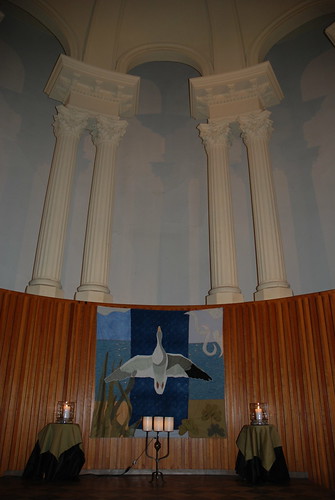
As a part of the St. Patrick's theme, much of the weekend incorporated Celtic Christian traditions. The ancient Irish Christians found the dove to be an unsatisfactory symbol for them of the Holy Spirit. A dove was too domesticated. Rather, they saw in the goose the qualities they experienced from the Holy Spirit--seemingly cantankerous, noisy, maybe even a little obnoxious, yet ever graceful and stately and beautiful. But most importantly, never controllable or tameable or predictable. I'm still loving this image of the Holy Spirit who leads us.
So this fabric icon was made by a local artist.
posted by Peter at 9:00 AM
|
|
permalink |

about
*oligopistos - Greek, noun, "one of little faith." This is where you eavesdrop on my scribblings about my life in the Kingdom, the Church, the world and the theological academy.
the author
> email
> AIM: RoyalBrougham11
> 101 things
> my photos
> my library
> my music
> my space
> mariner musings (2/03-2/05)
> xmas list
daily prayer
listening

www.flickr.com
|

(the oh-5)
> the.rock.umc
> aaron.mansfield.
> jackie.white.
> john.gallaher.
> maggie.middleton.
> rosario.picardo.
other friends
> aaron.klinefelter.
> alan.creech.
> bryan.sherwood.
> chad.brooks.
> dg.hollums.
> eric.herron.
> greg.fish.
> isaac.hopper.
> jason.evans.
> jeff.ling.
> kevin.rains.
> krista.hershey.
> kyle.potter.
> lawson.stone.
> meredith.brooks.
> pete.mathews.
> scot.mcknight.
> scott.collins.
> will.samson.
zines
> paste.
> next.wave.
> fast.company.
> biblical.archaeology.review.
baseball
> baseball.analysts.
> baseball.primer.
> baseball.reference.
> baseball.toaster.
> bronx.banter.
> cardinal.virtue.
> catfish.stew.
> cub.town.
> distinguished.senators.
> dodger.hill.
> dodger.thoughts.
> humbug.journal.
> mudville.magazine.
> pinstriped.bible.
> uss.mariner.
fotos
> jason&kelly.white.
> dave.cameron.
> top left pixel
> ken.rockwell.
> by thom
> pop photography
tunes
> pitchfork.media.
> each.note.secure.
> you.aint.no.picasso.
> my.old.kentucky.blog.
> brooklyn.vegan.
> bored.again.christian.
> kexp
> woxy
odds.and.ends.
> starbucks.gossip.
> coffee.geek.
> strong bad's email
body of christ
> the.rock.umc.(lexington).
> vine.and.branches.(lexington).
> clear.river.(centreville).
> mars.hill.(seattle).
> bc.(tulsa).
> fumc.(tulsa).
previous
> Commissioning
> Day on monotonous ritual
> Deuteronomy 28: 2/13
> So what happens now?
> Deuteronomy 28: 2/12
> Deuteronomy 28: 2/11
> Recalibration
> Deuteronomy 15: 10/30
> Deuteronomy 15: 10/29
> Deuteronomy 14: 10/23
archives
> 11/01/2003 - 12/01/2003
> 12/01/2003 - 01/01/2004
> 01/01/2004 - 02/01/2004
> 03/01/2004 - 04/01/2004
> 07/01/2004 - 08/01/2004
> 08/01/2004 - 09/01/2004
> 09/01/2004 - 10/01/2004
> 10/01/2004 - 11/01/2004
> 11/01/2004 - 12/01/2004
> 12/01/2004 - 01/01/2005
> 01/01/2005 - 02/01/2005
> 02/01/2005 - 03/01/2005
> 03/01/2005 - 04/01/2005
> 04/01/2005 - 05/01/2005
> 05/01/2005 - 06/01/2005
> 06/01/2005 - 07/01/2005
> 07/01/2005 - 08/01/2005
> 08/01/2005 - 09/01/2005
> 09/01/2005 - 10/01/2005
> 10/01/2005 - 11/01/2005
> 11/01/2005 - 12/01/2005
> 12/01/2005 - 01/01/2006
> 01/01/2006 - 02/01/2006
> 02/01/2006 - 03/01/2006
> 03/01/2006 - 04/01/2006
> 04/01/2006 - 05/01/2006
> 05/01/2006 - 06/01/2006
> 06/01/2006 - 07/01/2006
> 07/01/2006 - 08/01/2006
> 08/01/2006 - 09/01/2006
> 09/01/2006 - 10/01/2006
> 10/01/2006 - 11/01/2006
> 11/01/2006 - 12/01/2006
> 12/01/2006 - 01/01/2007
> 01/01/2007 - 02/01/2007
> 02/01/2007 - 03/01/2007
> 03/01/2007 - 04/01/2007
> 04/01/2007 - 05/01/2007
> 05/01/2007 - 06/01/2007
> 06/01/2007 - 07/01/2007
> 07/01/2007 - 08/01/2007
> 08/01/2007 - 09/01/2007
> 09/01/2007 - 10/01/2007
> 10/01/2007 - 11/01/2007
> 02/01/2008 - 03/01/2008
> 03/01/2008 - 04/01/2008
> 06/01/2008 - 07/01/2008


